
5 Mistakes Lexington Homeowners Make After a Flood
 By Lamar Wilson, Lexington KY Water Damage Restoration
Quick Answer
After a flood in Lexington KY, do not enter the home without turning off electricity, do not use box fans instead of professional drying equipment, do not discard damaged items before documenting them for insurance, do not wait more than 48 hours before calling a professional, and do not assume flood water is clean. All five mistakes worsen damage and can compromise your insurance claim.
Flooding is not a rare event in central Kentucky. Town Branch Creek and the North Elkhorn and South Fork Elkhorn watersheds bring real flood exposure to Lexington neighborhoods every spring. Clay soil that saturates quickly, limestone bedrock that cannot absorb groundwater fast enough, and aging drainage infrastructure in older parts of the city all contribute to flooding that catches homeowners off guard even when they have lived in their homes for years.
What homeowners do in the hours immediately after a flood often determines how much damage the home sustains, how quickly it recovers, and whether an insurance claim is paid in full. The mistakes in this article are the ones we see most often. They are also the most preventable.
The FEMA guidance on flood response is a useful starting point, but it addresses general safety rather than the specific property protection steps that affect your restoration outcome and your claim. This article is focused on what happens after you are safe and your family is out of harm’s way.
Mistake 1: Entering a Flooded Home Before Turning Off Electricity
Standing water and live electrical circuits are a fatal combination. This mistake kills people every year. The electricity in a flooded home must be shut off at the main breaker before anyone enters, even if only a few inches of water are on the floor. If the main breaker is in the basement or in an area you cannot reach without entering the water, call your utility company and ask them to cut power from outside before you go in.
What to do instead: Before you enter a flooded home, call your utility company if needed and confirm power is off. If you cannot confirm it is off, do not enter. This applies to the homeowner, family members, and any workers who arrive to help. No salvageable item in a flooded home is worth that risk.
This is the top item in FEMA’s flood safety guidance for good reason. Lexington homeowners dealing with spring flooding along the North Elkhorn corridor or in low-lying neighborhoods sometimes return to their homes before conditions are fully safe. Take the time to confirm power status first.
Mistake 2: Using Box Fans and Household Dehumidifiers Instead of Calling a Professional
This is the most common mistake we see, and it is the one that most consistently turns a manageable situation into a mold remediation job. Box fans and household dehumidifiers move surface air and reduce ambient humidity. They do not pull moisture out of concrete slabs, wood framing, insulation, or drywall.
Floors and walls can appear and feel completely dry while holding enough moisture inside the structural materials to support mold growth for weeks. Lexington’s humid summers make this worse. A basement that took on water in May and was dried with fans will often show mold growth by July, even in areas that looked fine after the initial cleanup.
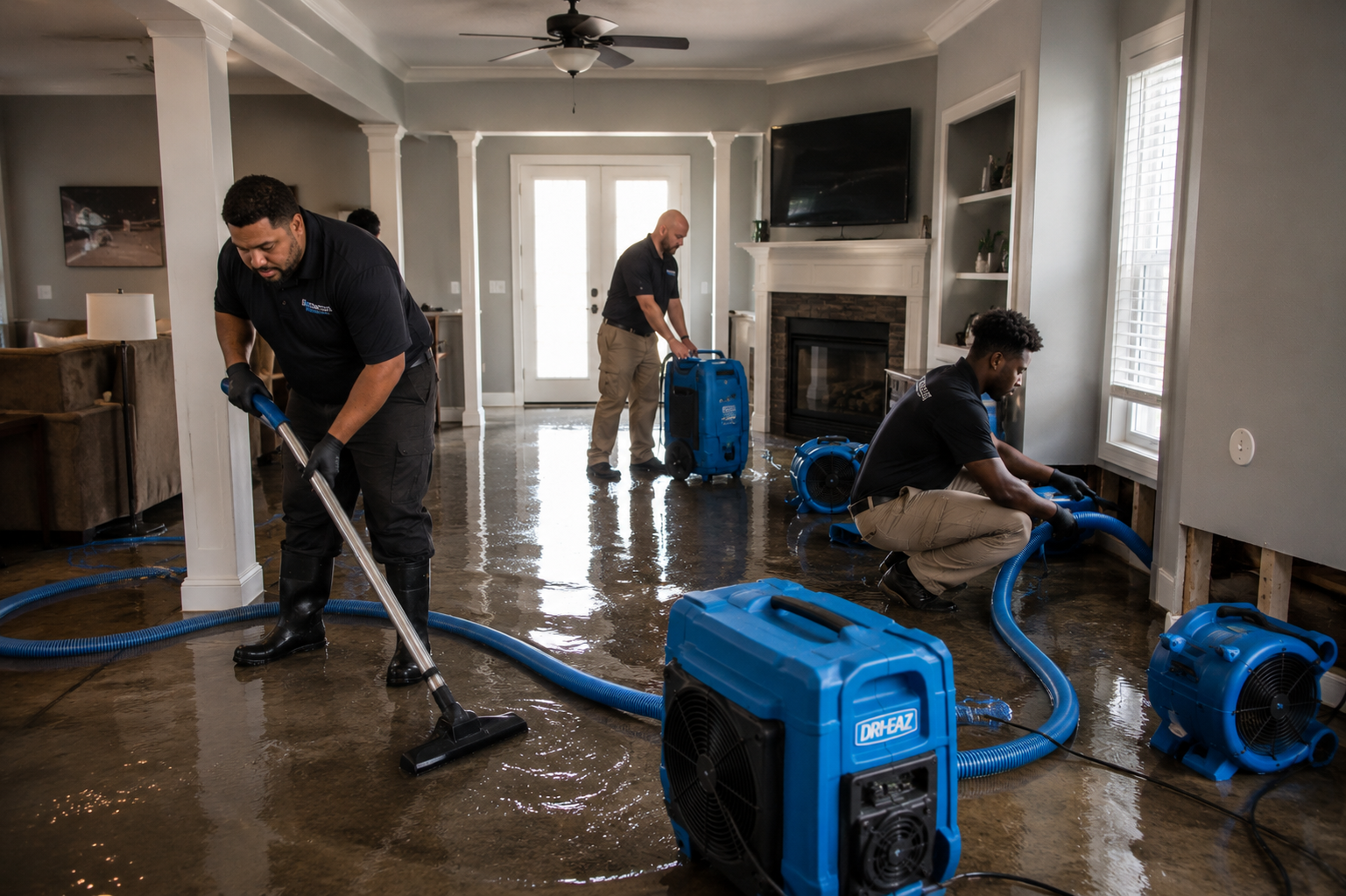
What to do instead: Start removing standing water with a shop vac or wet-dry vacuum to limit immediate damage, then call a professional restoration company. Commercial air movers and desiccant dehumidifiers are calibrated for structural drying. The job is not done when the floor looks dry. It is done when calibrated moisture meters confirm that walls, floors, and framing have reached acceptable moisture content. See our flood cleanup page for a full breakdown of the professional process.
Mistake 3: Throwing Away Damaged Items Before Documenting Them
The instinct after a flood is to start cleaning. That is understandable. But discarding flood-damaged furniture, flooring, appliances, and personal property before photographing and listing them is one of the most common ways homeowners reduce their own insurance payouts.
Your homeowners policy covers personal property losses up to the limits in your policy. But the adjuster needs an itemized list of what was damaged or destroyed, supported by photographs showing the damage. In Kentucky, where homeowners policies vary significantly in their personal property coverage terms, the burden is on the policyholder to document the loss.
What to do instead: Before moving or discarding anything, walk through the affected area and photograph everything from multiple angles. Create a written list of every item that was damaged, including approximate age and replacement value. Only after that documentation is complete should you move damaged items outside or to a staging area for the adjuster to review. Keep the items until the adjuster has seen them or signed off on the list.
This applies specifically in Lexington to events that affect finished basements. Homeowners with finished basement spaces, home offices, or media rooms often rush to protect salvageable electronics and furniture, discarding what looks clearly ruined. That ruined material has monetary value in your insurance claim. Document it first.
Mistake 4: Waiting More Than 48 Hours to Call a Professional
Mold can begin growing within 24 to 48 hours of a flood event. Wood framing begins to swell and can permanently deform within 48 to 72 hours. Drywall that has been wet for more than 48 hours is almost always past saving. These are not estimates with wide margins. They are documented biological and materials science timelines.
Lexington homeowners sometimes wait because they are waiting for an insurance adjuster to come out and assess the damage before work begins. This is understandable but is based on a misunderstanding of how insurance and restoration work together. You do not need to wait for an adjuster before beginning mitigation. You need to document the damage before it changes, and then begin mitigation immediately.
Delaying mitigation can actually hurt your claim rather than help it. If an adjuster or insurance company can argue that the damage worsened because of your failure to mitigate, they may reduce your payout for the additional damage that occurred while you waited.
What to do instead: Call a restoration company as soon as you have documented the initial damage with photographs. Begin mitigation immediately. Your adjuster will receive the professional restoration company’s documentation from the job, which is typically more useful for claim processing than an early adjuster visit to a still-wet property anyway. For a breakdown of what happens hour by hour after a water event, see our emergency water damage page.
Mistake 5: Assuming Flood Water Is Clean
This mistake specifically affects homeowners dealing with spring flooding from local waterways, storm drains, and sewer systems. Water that entered your home from outside during a storm or flood event is not clean water. It has moved across ground surfaces, through drainage systems, and potentially through sewer infrastructure. It carries bacteria, sediment, and contaminants that are invisible to the eye.
The restoration industry classifies water into three categories. Category 1 is clean water from a sanitary source such as a supply pipe. Category 2 is gray water with some contamination, such as an appliance overflow. Category 3 is black water with significant contamination, including floodwater from outside, sewage backups, and any water that has been standing for more than 48 hours regardless of original source.
This matters because Category 2 and Category 3 water require different protocols. Materials that absorbed contaminated water cannot always be dried and saved. Porous materials including carpet, carpet padding, and lower sections of drywall that contacted Category 3 water are almost always removed rather than dried in place. Attempting to dry and retain those materials is a health risk.
What to do instead: Treat any water that entered from outside the home, from a floor drain backup, or from any unidentified source as potentially contaminated. Do not walk through it barefoot. Do not allow children or pets into the area. Call a professional who can assess the water category and recommend the appropriate protocols. In Lexington, events that send water from the Town Branch Creek or North Elkhorn drainage systems into homes always involve Category 3 water, full stop.
Flood Response Questions
Do not enter a flooded home before confirming electricity is off. Do not use box fans and household dehumidifiers in place of professional equipment. Do not discard damaged items before documenting them for your insurance claim. Do not wait more than 48 hours before calling a professional. And do not assume the water is clean, especially if it entered from outside during a storm or flood event.
Mold begins within 24 to 48 hours. Wood framing swells and begins permanently deforming within 48 to 72 hours. Drywall that has been wet for more than 48 hours is usually not salvageable. Lexington’s humid summers accelerate all of these timelines, particularly in enclosed spaces like basements and closets. The window for limiting damage is short. Call a professional as quickly as possible.
No. You are required to mitigate your loss under your homeowners policy, which means taking steps to prevent further damage. Waiting for an adjuster while the damage worsens can reduce your claim. Document the initial damage with photographs, then begin mitigation immediately. Your restoration company provides professional documentation from the job that is useful for your claim.
No. Floodwater from outside is classified as Category 3 water and carries bacteria, sediment, and contaminants from drainage systems, ground surfaces, and potentially sewer infrastructure. In Lexington, any water that entered from outside during a storm or that came from a floor drain backup should be treated as contaminated. Do not allow barefoot contact, and keep children and pets out of the affected area until it has been professionally assessed and cleaned.
Serving Lexington and Central Kentucky
Tell Us What Happened
We will call you back within the hour.